Bridges · Scotland
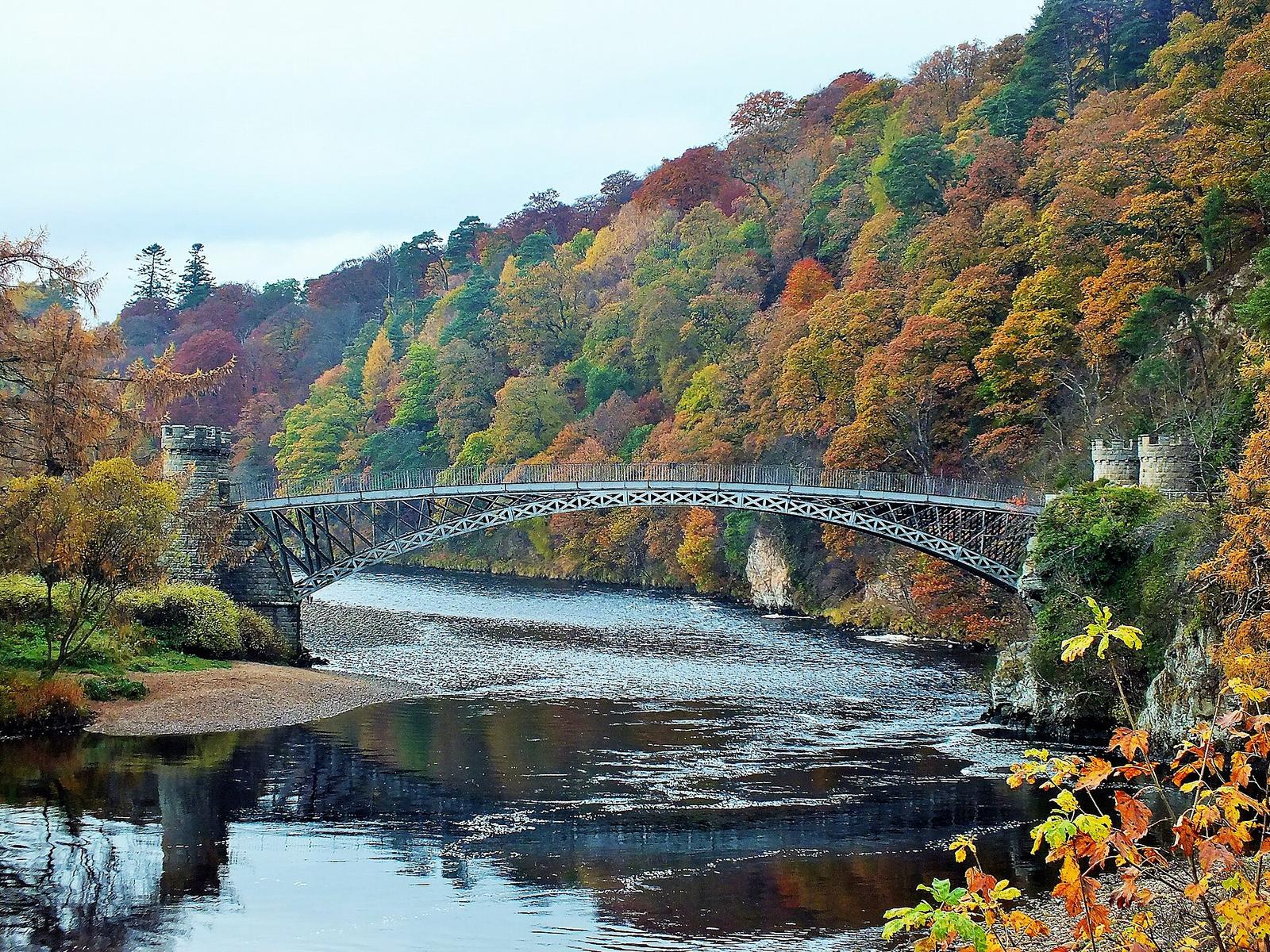
Craigellachie BridgeIron bridge by Thomas Telford (1814), Moray, Scotland
- Type
- Iron bridge
- Built
- 1814
- Where
- MorayScotland
- Today
- Standing (footbridge)
- Telford's part
- Designer
- Location
- 57.4913, -3.1939approximate
A single slender cast-iron arch, 150 feet across, carries Telford's old road over the River Spey at Craigellachie. Built in 1812 to 1814, it is the oldest surviving iron bridge in Scotland, and it is now for walkers only.
What you are looking at
The main span is an arch of four parallel ribs, each about 3 feet deep and cast in seven pieces, with a deck of iron plate 13 and a half feet wide. Between the ribs and the roadway, the spandrels are filled with a light lattice of diamond-shaped iron bracing. The arch rises about 20 feet. At each end castellated stone turrets, with false arrow slits, flank the approach. Three small stone arches on the south-east side carry the road to the iron span.
Iron let Telford do what stone could not on this river. A masonry bridge would have needed piers in the Spey, with the cost and risk of floods. A single iron arch springing from high granite abutments put nothing in the water. Local advice led him to raise the bridge by several feet from his first plan, and when the great floods of 1829 swept the river, it was the only bridge on the Spey left standing.
Who built it
An appeal for a bridge went out in October 1812, after people had died trying to cross the river. Telford designed it, and William Hazledine cast the ironwork at Plas Kynaston at Cefn Mawr in Denbighshire, close to Pontcysyllte. A cast-iron plaque at the Banff end still reads "Cast at Plas Kynaston Ruabon Denbighshire" with the date 1814. The iron came north by canal, sea and cart, and the arch weighed about 180 tons. William Stuttle, Telford's foreman, erected it, and John Simpson of Shrewsbury did the masonry.
The design was a type. Telford produced a portable, lattice-braced standard bridge for wide sites where stone was impractical, and at least ten were put up across Britain between 1814 and 1829. Craigellachie is the earliest that survives.
What changed after 1814
The deck was strengthened in 1902. In 1963 to 1964 the bridge was reconstructed above the ribs, with the arch ribs themselves preserved, and a plaque records the work by the county councils of Banffshire, Moray and Nairn. A new bridge took the traffic, and the old one closed to vehicles in 1972. It is a Category A listed building and an International Historic Civil Engineering Landmark.
Visiting
- Walk across. The bridge is pedestrian only. There is a small car park just off the A941 beside the modern bridge, and the old bridge is a short walk from the village of Craigellachie.
- See it from the river. Paths lead down to the riverside, and the view of the arch from below shows how thin it is. The modern road bridge gives a good view from above.
- Speyside Way. The long-distance path passes close by, and the bridge is a short detour from it.
There have been works on and around the bridge in recent years, so check locally that the crossing is open before you travel.
Questions people ask
How long is Craigellachie Bridge?
The iron arch spans 150 feet (45.7 metres) over the River Spey.
When was it built?
Between 1812 and 1814. The ironwork carries the date 1814.
Can you cross it?
Yes, on foot. It has been closed to vehicles since 1972.
Is it the original bridge?
The cast-iron arch is original. The deck was strengthened in 1902 and rebuilt above the ribs in 1963 to 1964.
Where did the iron come from?
From William Hazledine's foundry at Plas Kynaston, Cefn Mawr, in north Wales. It travelled north by canal, by sea and by horse-drawn cart.
Did Telford build it alone?
No. Hazledine cast the iron, William Stuttle erected it and John Simpson built the stonework to Telford's design.
On the map
Open on the full map · Directions