Harbours and docks · England
St Katharine DocksDocks by Thomas Telford (1828), London, England
- Type
- Docks
- Built
- 1828
- Where
- LondonEngland
- Today
- In use (marina)
- Telford's part
- Engineer
- Location
- 51.5070, -0.0720approximate
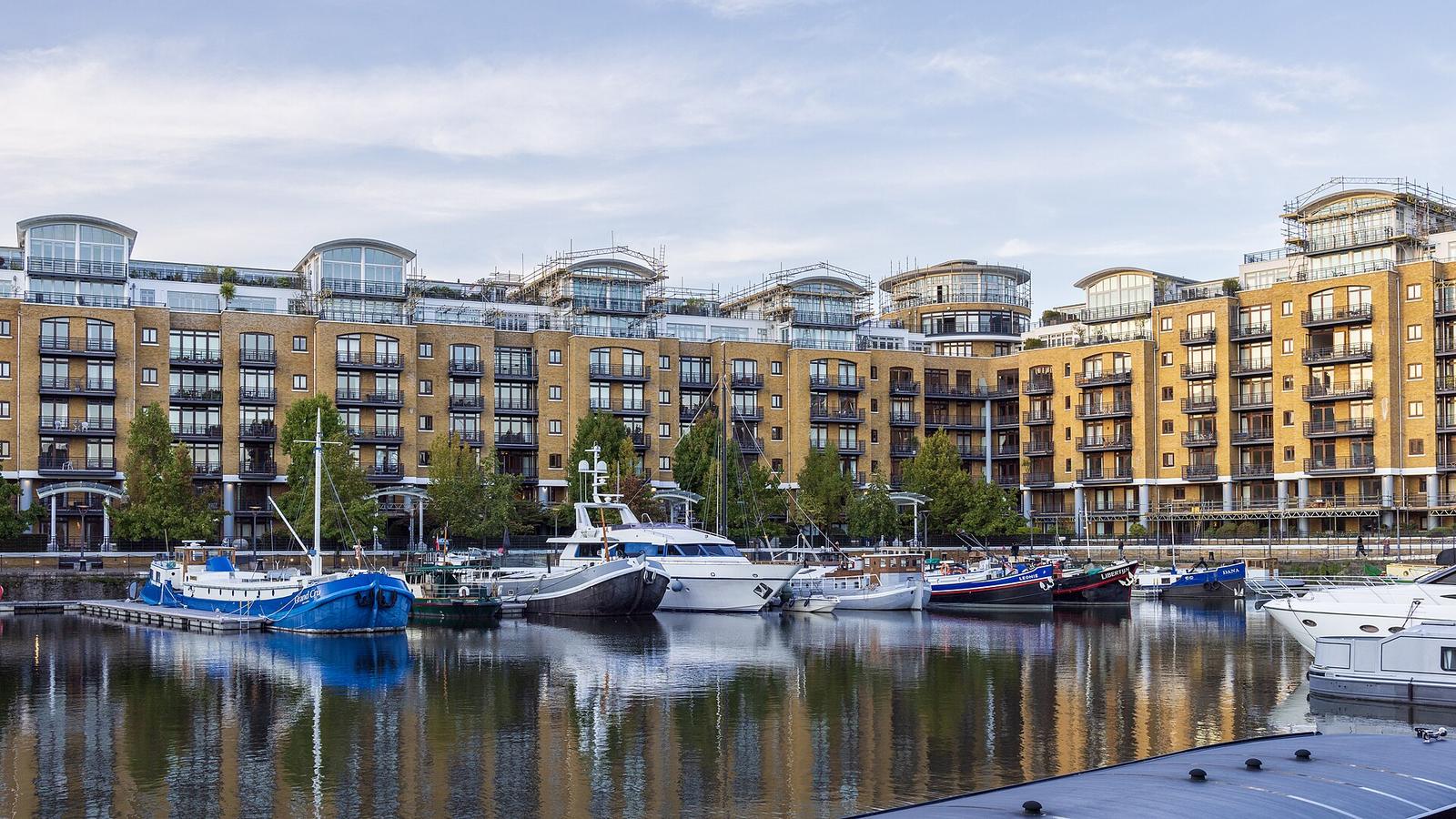
Telford's London dock was squeezed onto a crowded site beside the Tower. St Katharine Docks opened in 1828 and closed to commercial shipping in 1968. The two basins are still there, now a marina in the shadow of Tower Bridge.
What you are looking at
The docks are two linked basins, East and West, each reached through an entrance lock from the Thames. The site was small and hemmed in, so Telford worked to keep activity on the quayside to a minimum. He had Philip Hardwick design the warehouses to stand directly on the quay, with cast-iron columns rising from the water's edge and open ground floors, so goods could be lifted from a ship straight into the building. Steam engines designed by James Watt and Matthew Boulton kept the water in the basins about four feet above the tidal river.
Warehouses on the quay saved space, but the docks could not take the larger ships that were coming into service, and they were never a great commercial success. They were later amalgamated with other London dock companies.
Who built it
Parliament authorised the docks in 1825, and Telford was the engineer. Work began in May 1827 and the docks opened on 25 October 1828, with a modest ceremony. Philip Hardwick was the architect of the warehouses. Peter Logan was the resident engineer, followed by John Hall.
The price was paid in the neighbourhood. About 1,250 houses were demolished, along with the medieval hospital of St Katharine, founded in 1148 by Queen Matilda, and its church. Around 11,300 people lost their homes, and only the owners of the property were compensated.
What happened next
German bombing badly damaged the docks in the Second World War, and all the warehouses around the eastern basin were destroyed. The entrance lock was rebuilt in 1957. The docks were among the first in London to close, in 1968, and were sold to the Greater London Council. Most of the remaining warehouses on the western side were demolished in the early 1970s, starting with the Tower Hotel, which opened in 1973. The basins were kept and turned into a yacht marina.
Visiting
- Walk round the basins. The docks are now a marina and leisure complex. Small and medium boats use them daily, and Thames sailing barges are based here.
- Dickens Inn. The former brewery dating from the eighteenth century is now a pub, and the Amsterdam anchor, from a Dutch East Indiaman wreck, stands by the entrance to the east dock.
- Tower Bridge. The docks sit just downstream of the Tower of London and Tower Bridge.
- Getting there. Tower Hill station and Tower Gateway station on the DLR are both close, about equally far from the docks' north-west corner.
Much of what you see round the basins is later building, so look for the dock layout rather than Telford's own warehouses.
Questions people ask
When did St Katharine Docks open?
On 25 October 1828, about a year and a half after building began.
Did Telford design the warehouses?
No. Telford was the engineer of the docks. Philip Hardwick designed the warehouses.
What was demolished to build them?
About 1,250 houses and the medieval Hospital of St Katharine, displacing around 11,300 people.
Are the docks still used?
Yes, as a marina. Commercial shipping ended in 1968.
Why are there two basins?
The docks were laid out as an East and a West basin, linked to each other and each reached from the Thames through its own entrance lock.
On the map
Open on the full map · Directions