Canals and aqueducts · Scotland
Clachnaharry Sea LockLocks by Thomas Telford (1822), Inverness, Scotland
- Type
- Locks
- Built
- 1822
- Where
- InvernessScotland
- Today
- In use
- Telford's part
- Engineer
- Location
- 57.4904, -4.2628approximate
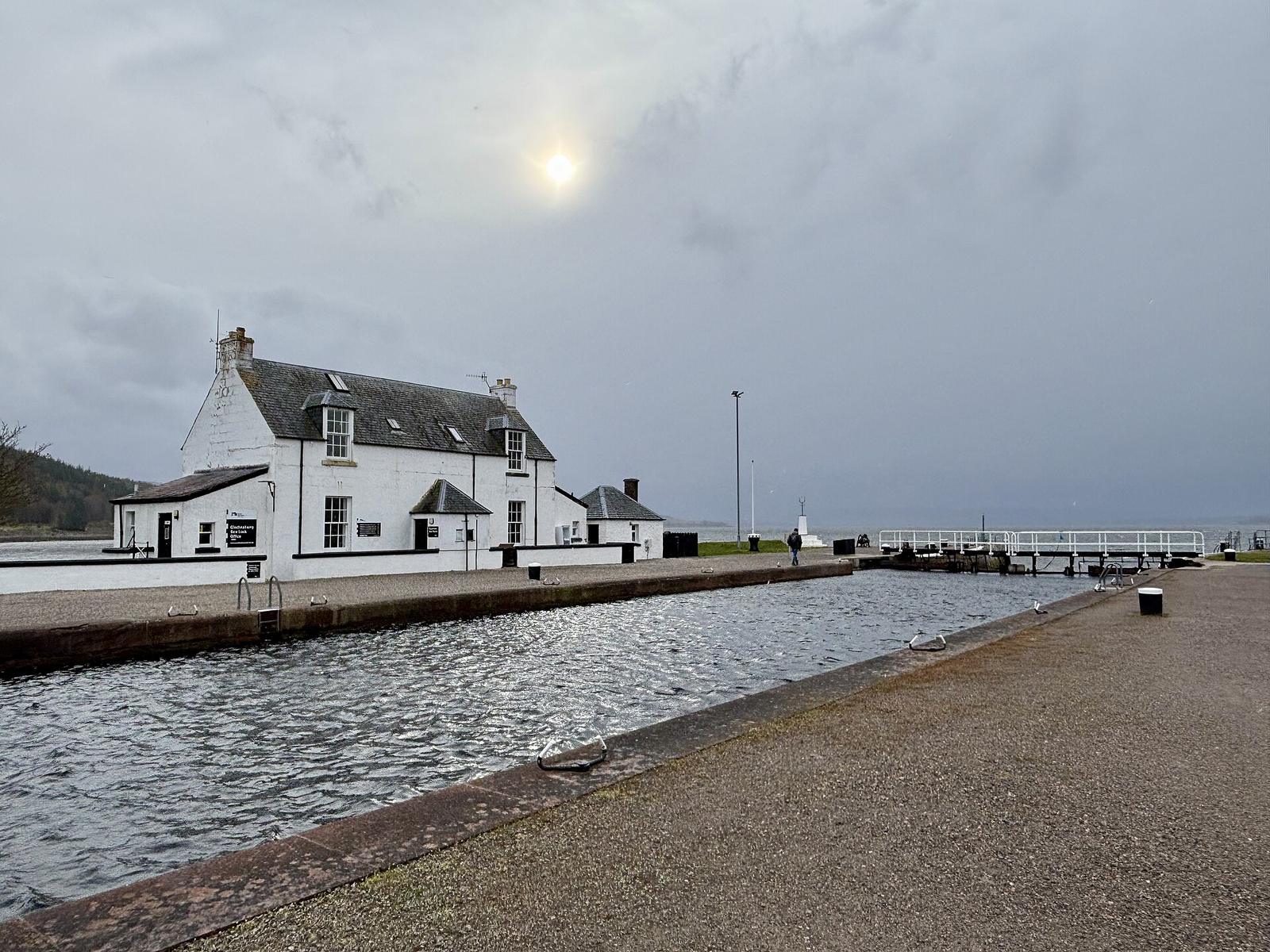
Clachnaharry Sea Lock is the Inverness end of the Caledonian Canal. It stands at the tip of a man-made peninsula pushed out into the Beauly Firth, so that boats can always reach the canal in deep water. The scheduling description calls it one of the hardest parts of the canal to build.
What you are looking at
To reach deep water, two embankments, each about 365 metres long, were built out across the tidal flats. The lock was then dug out between them, and the sea water had to be removed by hand pumps and a chain pump worked by horses. The embankments still need constant maintenance. Beside the lock is a lock-keeper's cottage, the former workshops and smithy, and Dunolly, a house above the lock where Telford stayed on his brief visits during construction.
The scheduled monument runs from the sea lock to the south end of Muirtown Quay and includes Muirtown Basin and the four Muirtown locks above it.
Who built it
Telford was principal engineer of the canal, with William Jessop as consulting engineer, and work began at both ends in 1804. The deep, soft ground at Clachnaharry was one of the hardest problems on the whole canal. The lock-keeper's cottage is thought to date from when the sea lock was built, after 1818. The canal opened in 1822.
The lock-keeper's cottage and Dunolly are Category C listed, and the former canal workshops and smithy are Category B.
Visiting
- Walk the embankment. You can walk out along the peninsula to the sea gates, with the Beauly Firth beyond.
- See the old buildings. The east half of the lock-keeper's cottage is now the sea lock and canal office.
- Muirtown. The four Muirtown locks and the basin lie just beyond the sea lock and are part of the same scheduled area.
Scottish Canals manages the site. Check its website for lock times and any closures before you travel.
Questions people ask
Where is Clachnaharry Sea Lock?
On the Beauly Firth, at the north-east end of the Caledonian Canal, in the Clachnaharry district of Inverness.
Why does it stand on a peninsula?
The tidal flats were shallow, so two long embankments were built out to deep water and the lock was cut between them.
Is it protected?
Yes. It is part of a Scheduled Monument, and several buildings beside it are listed.
Where does the canal go from here?
South-west to Muirtown Basin and on through Loch Dochfour and Loch Ness towards Fort William.
On the map
Open on the full map · Directions