Canals and aqueducts · Scotland
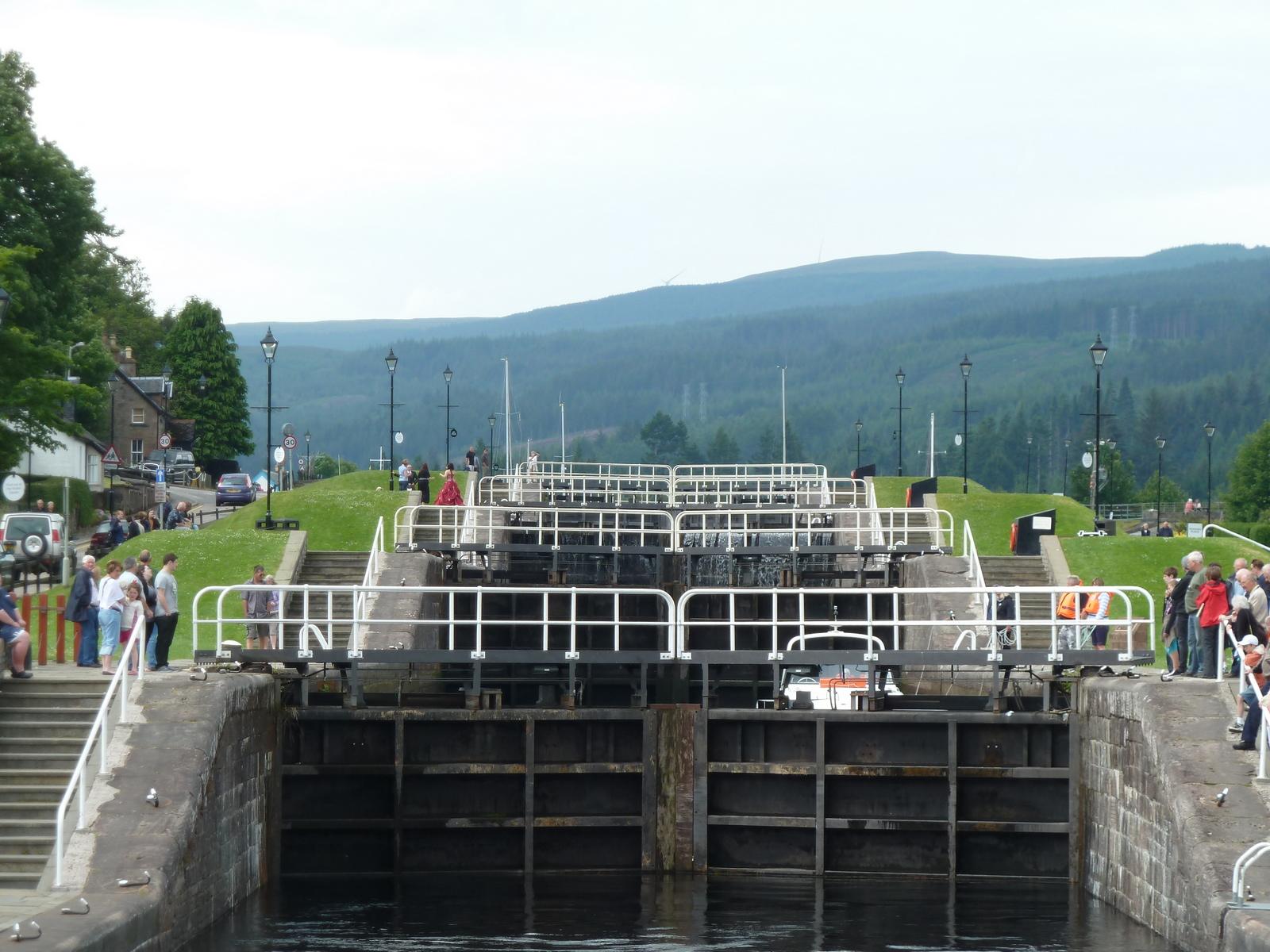
Fort Augustus LocksLocks by Thomas Telford (1822), Fort Augustus, Scotland
- Type
- Locks
- Built
- 1822
- Where
- Fort AugustusScotland
- Today
- In use
- Telford's part
- Engineer
- Location
- 57.1450, -4.6800approximate
At Fort Augustus the Caledonian Canal drops into Loch Ness through five locks that run straight through the middle of the village. They are arranged as a staircase, so each pair of gates serves two chambers.
What you are looking at
The five locks are a single flight, with the top gates of one lock acting as the bottom gates of the one above. They stand at the south-west end of Loch Ness, where the canal runs parallel to the River Oich. The stone for them came from the new cutting dug for the river. The A82 crosses the canal on a swing bridge at the foot of the flight, built in 1932 by Sir William Arrol and Company.
The ground here was a problem. American engineering historians note that the very porous gravel soils at Fort Augustus needed extensive dewatering during construction.
Who built it
Telford was principal engineer, with William Jessop as consulting engineer. Work on the canal began in 1804 and it opened in 1822. The poet Robert Southey visited the works at Fort Augustus in September 1820 and wrote a lively description of the five locks under construction.
The canal was designed for sea-going ships, so the chambers are 180 feet long and 40 feet wide. The whole canal is a Scheduled Monument, and the Fort Augustus locks are part of that.
Visiting
- Watch the flight. The locks run through the middle of the village, so you can see boats working up or down from the road and the lock sides.
- Heritage centre. A small Caledonian Canal heritage centre in the village covers the history of the canal.
- Loch Ness. The canal basin opens onto the loch at the foot of the locks.
Scottish Canals manages the canal. Check its website for lock times and any closures before you travel.
Questions people ask
How many locks are there at Fort Augustus?
Five, arranged as a staircase.
Who built them?
They were built for the Caledonian Canal Commissioners under Telford, with Jessop as consulting engineer.
Are they still used?
Yes. The canal is navigable, and boats use the flight to move between Loch Ness and the rest of the canal.
Is the road bridge original?
No. The swing bridge at the foot of the locks dates from 1932.
On the map
Open on the full map · Directions