Canals and aqueducts · Wales
Chirk AqueductAqueduct by Thomas Telford (1801), Wrexham, Wales
- Type
- Aqueduct
- Built
- 1801
- Where
- WrexhamWales
- Today
- Standing / in use
- Telford's part
- Engineer (with Jessop)
- Location
- 52.9279, -3.0628approximate
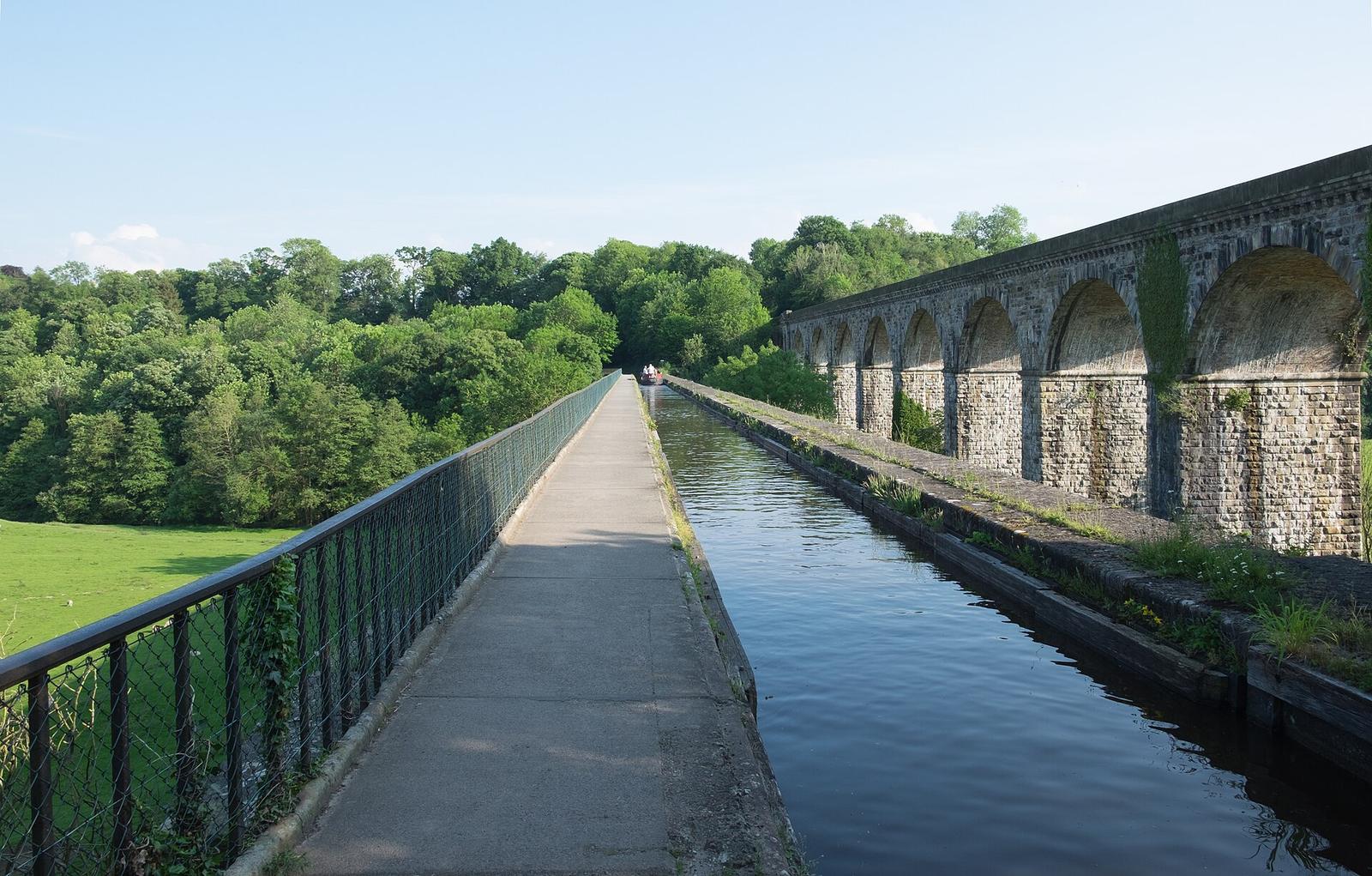
Chirk Aqueduct is the older and smaller sibling of Pontcysyllte. Ten stone arches carry the Llangollen Canal 70 feet above the River Ceiriog, and the trough on top is cast iron. It opened in 1801, and for a short time it was the tallest navigable aqueduct in the world.
What you are looking at
The aqueduct is 710 feet (220 metres) long and has ten arches, each spanning 40 feet. The canal runs 65 feet above the ground and about 70 feet above the river. From outside it looks like a masonry aqueduct, but the water is held in a cast-iron trough hidden inside the stone walls. Telford and William Jessop used iron base plates instead of a thick layer of puddled clay, which would have been too heavy for the piers. The piers are hollow to save weight. The towpath runs along the east side, behind cast-iron railings, and the aqueduct crosses the border between England and Wales.
Side plates were added in 1870. The canal goes straight from the north end of the aqueduct into Chirk Tunnel.
Who built it
The Ellesmere Canal Act was passed in 1793, and Jessop, the principal engineer, appointed Telford to supervise the works. The first plan, a large embankment near Chirk Castle, was vetoed by the castle's owner, so the canal was moved and an aqueduct and a tunnel took its place. Jessop and Telford then proposed an aqueduct that would be a feature of the view and not an obstruction. The foundation stone was laid on 17 June 1796 and the aqueduct opened in 1801. William Hazledine supplied the ironwork. Matthew Davidson, who was also resident engineer on other Telford works, was on site. It was finished four years before Pontcysyllte.
The Chirk railway viaduct stands beside it. The aqueduct is listed Grade II*, in Wales by Cadw and in England by Historic England.
The World Heritage Site
Chirk Aqueduct and Chirk Tunnel are part of the Pontcysyllte Aqueduct and Canal World Heritage Site, inscribed in 2009. The site runs from the Horseshoe Falls to just beyond Chirk, and takes in Pontcysyllte Aqueduct and Chirk Tunnel.
Visiting
- Walk across. The towpath over the aqueduct is open and runs straight on to Chirk Tunnel.
- See it from below. The valley below shows the arches against the sky, with the railway viaduct next to them.
- Chirk Castle. The castle, built for Edward I in 1295, stands near the valley. Its owner's veto of an embankment is why the canal crosses here on an aqueduct.
Check the Canal and River Trust site for boat services, towpath closures and access before you travel.
Questions people ask
How high is Chirk Aqueduct?
About 70 feet (21 metres) above the River Ceiriog. The canal itself is about 65 feet above the ground.
How long is it?
710 feet (220 metres), carried on ten arches of 40 feet.
Can you walk across it?
Yes. The towpath on the east side is open.
Is it in Wales or England?
Both. It crosses the Ceiriog valley and the border between England and Wales.
Did Telford build it alone?
No. He and William Jessop designed it for the Ellesmere Canal Company, and Hazledine supplied the iron.
On the map
Open on the full map · Directions
Nearby Telford works
- Chirk TunnelCanal tunnel · 0.3 miles away
- Holyhead Road milestone, Chirk Road, Weston Rhyn (SJ 2955 3707)Milestone · 0.6 miles away
- Telford Milestone 83, ChirkMilestone · 0.6 miles away
- Holyhead Road milestone, Weston Rhyn (SJ 29977 35737)Milestone · 1.3 miles away
- Holyhead Road milestone, Gobowen (SJ 3011 3413)Milestone · 2.1 miles away
- Holyhead Road milestone, Gobowen (SJ 3020 3256)Milestone · 3.1 miles away