Canals and aqueducts · Wales
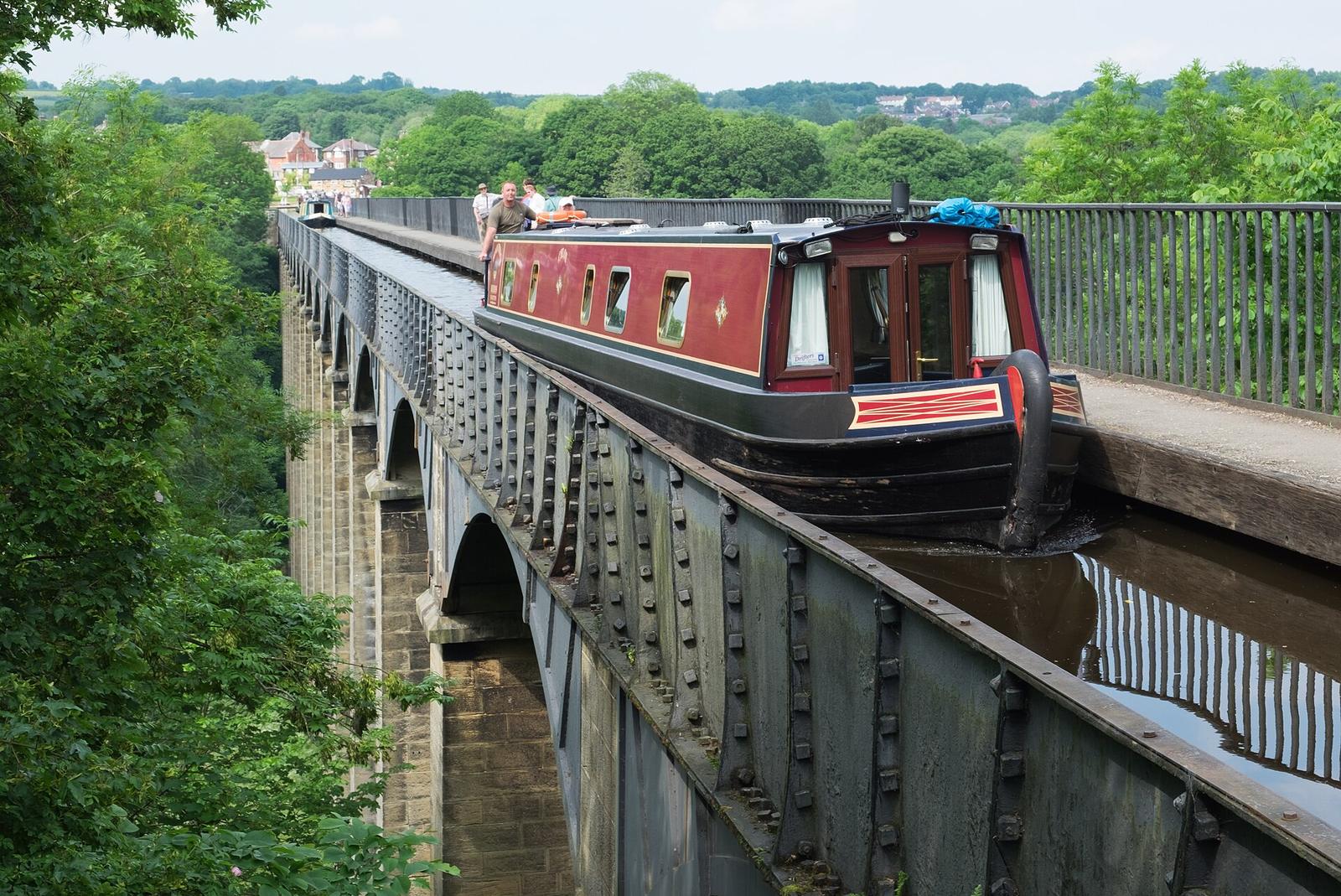
Pontcysyllte AqueductAqueduct by Thomas Telford (1805), Wrexham, Wales
- Type
- Aqueduct
- Built
- 1805
- Where
- WrexhamWales
- Today
- Standing / in use
- Telford's part
- Engineer (with Jessop)
- Location
- 52.9706, -3.0878approximate
The highest canal aqueduct in Britain carries the Llangollen Canal across the Vale of Dee in a cast-iron trough held 38 metres above the river. Boats cross it, people walk it, and it has been doing the job since 1805.
What you are looking at
The trough is a long iron box, cast in sections at William Hazledine's foundry close by at Cefn Mawr and bolted together on site. It sits on 19 spans of cast-iron arches, which rest on 18 tall stone piers that taper as they rise. Making the piers hollow towards the top saved weight and stone. The towpath is cantilevered out over the water on one side, so a boat displaces water underneath it as it goes, and the far side has only the lip of the trough between a boat and the drop.
Iron was the daring part. Earlier aqueducts carried canals in heavy masonry channels lined with clay, which would never have stood at this height. A thin iron trough, with joints sealed by flannel and lead, meant the piers could be slender and the whole structure light enough to build across the gorge. Telford had tried the idea on a much smaller scale at Longdon-on-Tern in Shropshire a few years earlier.
Who built it
The aqueduct was built for the Ellesmere Canal Company, whose plan was to link the Dee and the Mersey with the Severn. Telford was the company's general agent and engineer on the ground. William Jessop was its senior engineer, and historians still argue over how much of the design was his. Work began in 1795 and the aqueduct opened in November 1805. The canal it was built for was never finished as planned, and the stretch through here became what is now the Llangollen Canal.
The World Heritage Site
In 2009 the aqueduct and 11 miles of the canal around it became a UNESCO World Heritage Site. The site runs from the Horseshoe Falls above Llangollen, Telford's curved weir that feeds the canal from the Dee, down to Gledrid near Chirk. It takes in Chirk Aqueduct, Chirk Tunnel and the Horseshoe Falls, all on this site.
Visiting
- Walk across. The towpath is open all year and free. Start at Trevor Basin at the north end, where there is parking and a visitor centre, and walk to Froncysyllte and back.
- Cross by boat. Trip boats cross the aqueduct from Trevor Basin, and from Llangollen Wharf further along the canal.
- See it from below. Paths lead down from both ends towards the river. The view from the riverbank shows the height and the slender piers far better than any view from the top.
- Heads for heights. The towpath side has railings. Most people find the crossing easy, but it is high and exposed in wind.
- By train. Ruabon is the nearest station, a few miles away.
Check boat times and visitor centre opening with the operators before you travel.
Questions people ask
How high is Pontcysyllte Aqueduct?
About 38 metres (126 feet) above the River Dee at its highest point. It is the highest canal aqueduct in Britain.
How long is it?
307 metres (1,007 feet), in 19 spans.
Can you walk across it?
Yes. The towpath along one side is a public path, open all year, with railings on the drop side.
How do you say Pontcysyllte?
Roughly "pont-kuh-SUHLTH-teh". Pont is Welsh for bridge, and Cysyllte is the name of the township at its southern end.
Did Telford build it alone?
No. He was the engineer in charge on site, working under William Jessop for the Ellesmere Canal Company. William Hazledine cast the ironwork, and Matthew Davidson was superintendent of the works on site.
On the map
Open on the full map · Directions
Nearby Telford works
- Telford Milestone 83, ChirkMilestone · 2.7 miles away
- Chirk TunnelCanal tunnel · 2.9 miles away
- Chirk AqueductAqueduct · 3.1 miles away
- Toll Gatehouse, LlangollenTollhouse · 3.1 miles away
- Holyhead Road milestone, Chirk Road, Weston Rhyn (SJ 2955 3707)Milestone · 3.4 miles away
- Holyhead Road milestone, Weston Rhyn (SJ 29977 35737)Milestone · 4.3 miles away