Canals and aqueducts · Wales
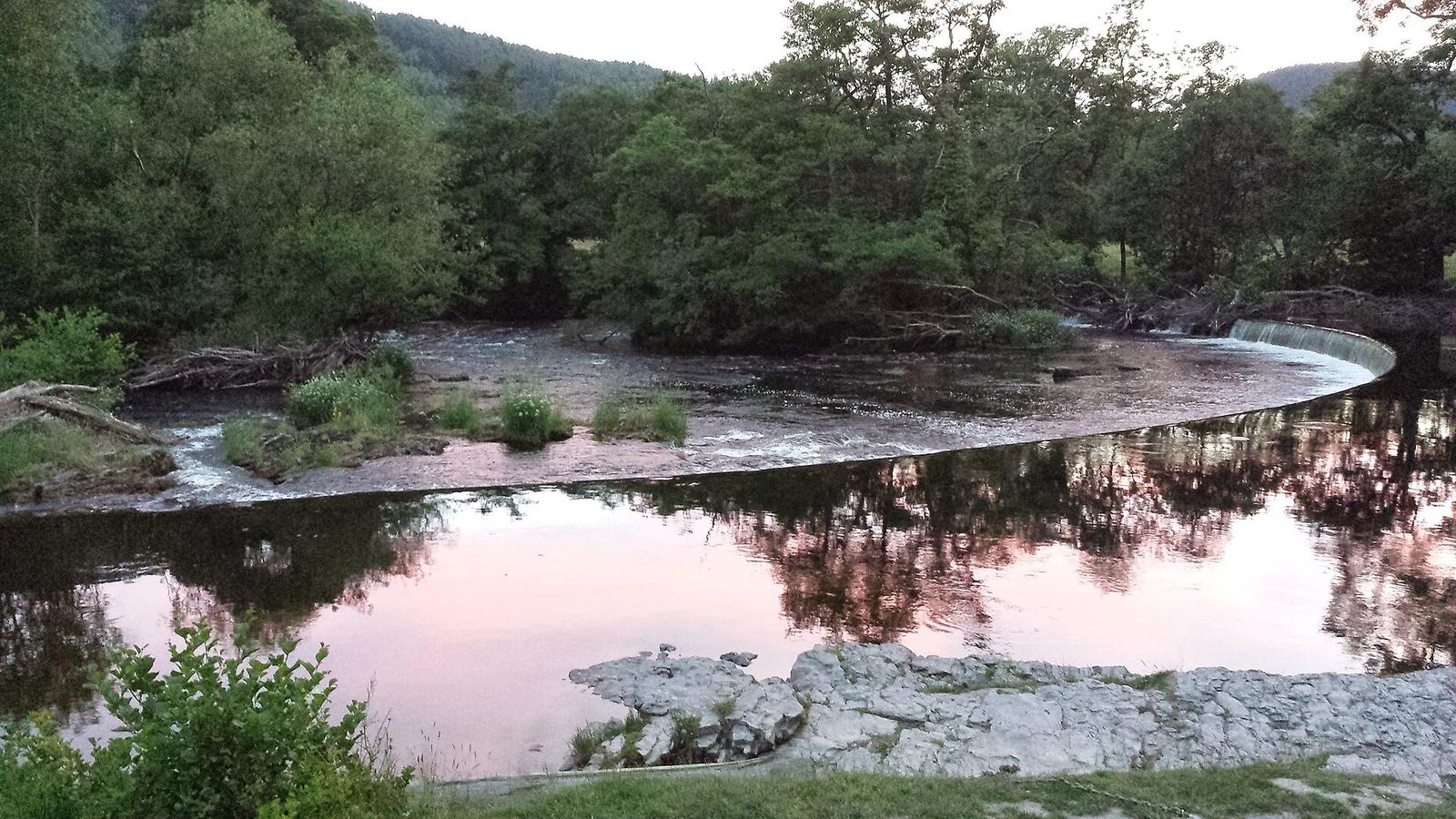
Horseshoe FallsWeir by Thomas Telford (1808), Denbighshire, Wales
- Type
- Weir
- Built
- 1808
- Where
- DenbighshireWales
- Today
- Standing
- Telford's part
- Designer
- Location
- 52.9814, -3.1996approximate
The Horseshoe Falls is not a waterfall at all. It is a curved stone weir across the River Dee, built to send a steady stream of water into the Llangollen Canal. Completed in 1808, it is where the Pontcysyllte World Heritage Site begins.
What you are looking at
The weir is about 140 metres (460 feet) long and just over a metre high. It curves in a near-crescent across a bend in the Dee, above a stretch of rapids, which gives it its name. Sluices and entrance pounds take water into the feeder canal. Sources differ on how much it draws today, from 6 million to about 12 million gallons a day. The water feeds the canal network and also supplies Cheshire.
The canal was meant to be the first part of a grand link between the Mersey, the Dee and the Severn. When the plan stopped short, the stretch from Pontcysyllte to Llangollen stayed in use as the feeder that carried this water, and the Horseshoe Falls is a big part of the reason the canal to Llangollen is still there.
Who built it
William Jessop, the Ellesmere Canal's engineer, proposed taking water from the Dee in 1795, and Telford built it. The feeder canal, about six miles long, was begun in 1804 and finished in 1808. The weir was partly destroyed by floods in the winter of 1820 to 1821, and rebuilt in 1821 with cast-iron edging added in 1822. It is a Grade II listed structure.
The World Heritage Site
In 2009 the weir and 11 miles of the Llangollen Canal, as far as Chirk, became a UNESCO World Heritage Site. It is the first link in a chain that runs through Pontcysyllte Aqueduct, Chirk Aqueduct and Chirk Tunnel.
Visiting
- Walk the towpath. The falls are about 3 km from Llangollen, and the towpath runs right up to the weir. A meadow beside it is a good place for a picnic.
- By train. Berwyn station on the Llangollen Railway is close to the falls.
- Chain Bridge. A chain bridge across the Dee is nearby, and the medieval St Tysilio's Church at Llantysilio is about an 11 minute walk.
- Parking. There is parking near the falls.
Stay back from the edge of the weir, and check the Canal and River Trust site before you travel.
Questions people ask
Is Horseshoe Falls a real waterfall?
No. It is a weir, a low stone dam about a metre high, built to feed water into the canal.
How long is the weir?
About 140 metres (460 feet).
Why did Telford build it?
To draw a steady supply of water from the River Dee into the Llangollen Canal, which fed the Ellesmere Canal network.
When was it built?
The canal was begun in 1804 and completed in 1808. The weir was rebuilt in 1821 after flood damage.
Is it part of the World Heritage Site?
Yes. It is where the Pontcysyllte Aqueduct and Canal World Heritage Site starts.
On the map
Open on the full map · Directions
Nearby Telford works
- Toll Gatehouse, LlangollenTollhouse · 1.7 miles away
- Pontcysyllte AqueductAqueduct · 4.7 miles away
- Chirk TunnelCanal tunnel · 6.6 miles away
- Telford Milestone 83, ChirkMilestone · 6.7 miles away
- Chirk AqueductAqueduct · 6.8 miles away
- Holyhead Road milestone, Chirk Road, Weston Rhyn (SJ 2955 3707)Milestone · 7.3 miles away