Bridges · Wales
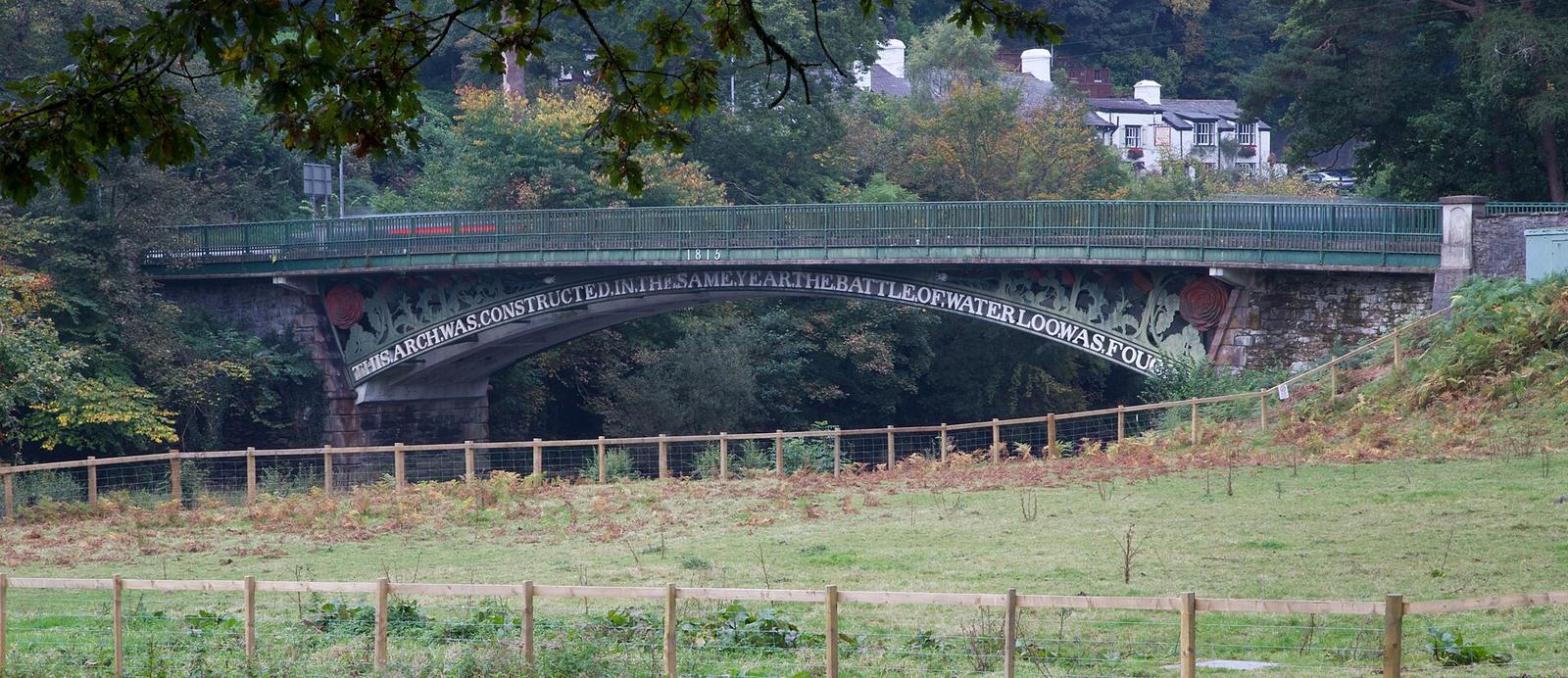
Waterloo Bridge (Betws-y-Coed)Iron bridge by Thomas Telford (1815), Conwy, Wales
- Type
- Iron bridge
- Built
- 1815
- Where
- ConwyWales
- Today
- Standing / in use
- Telford's part
- Designer
- Location
- 53.0852, -3.7954
Waterloo Bridge carries the A5 over the Conwy at Betws-y-Coed on a single cast-iron arch of 32 metres. Telford built it in 1815-16, and it is listed at Grade I.
What you are looking at
Cadw's listing describes a wide single-span iron road bridge with masonry springing. The span is 32 metres (105 feet) and is made of five cast-iron arched ribs set 1.5 metres apart, which carry cast-iron deck plates.
Raised lettering on the bridge names Telford as engineer, and the founder and foreman are named at the other end with the date 1815. A further inscription says the arch was built in the year of the battle of Waterloo, though the bridge did not open until the year after. The abutments were refurbished in 1923 and the three inner ribs were encased in concrete to strengthen it.
Who built it
The listing says Telford built it in 1815-16 as a key part of the new Shrewsbury to Holyhead road. The ironwork was cast by William Hazledine at Plas Kynaston, and the construction foreman was W. Stuttle.
See also the Holyhead Road in Wales, and Telford's other iron arch at Craigellachie.
Visiting
- Find it on the A5. The bridge is on the south-east approach to Betws-y-Coed, about half a mile from the village.
- Look for the lettering. The inscriptions are on the outside of the deck, at each end.
- Nearby. The Waterloo Hotel stands close to the bridge.
Check locally before you travel, as access and use can change.
Questions people ask
How long is the span?
32 metres, or 105 feet.
When was it built?
1815-16.
Is it listed?
Yes, at Grade I (Cadw reference 17827).
Who made the ironwork?
William Hazledine, at his Plas Kynaston works.
On the map
Open on the full map · Directions
Nearby Telford works
- Telford Milestone 45, Betws-y-CoedMilestone · 0.2 miles away
- Telford Milestone 46, Betws-y-CoedMilestone · 0.7 miles away
- Telford Milestone 44, Betws-y-CoedMilestone · 1.1 miles away
- Telford Milestone 47, Bont NewyddMilestone · 1.6 miles away
- Telford Milestone 43, Betws-y-CoedMilestone · 2.0 miles away
- Telford Milestone 48, Pont RhydlanfairMilestone · 2.5 miles away